
| One of America’s most venerable structures converts to a shelter for migrants—and parallels with the Fall of Rome are everywhere. |
During the five years I lived in Manhattan I never had to worry about hotels. My high-rise apartment building on 90th and Third was my home from ’76 to ‘81, after which I moved to the Connecticut suburbs and commuted into the city by train each day. But three years after that, I moved to Colorado and these days—when I return to New York (as I’m doing tomorrow on a business trip)—the first step is choosing a hotel. And that means focusing on location, location, and location.
Unlike most cities, in New York everything is so squished together you walk most places, not drive. So you want to choose a hotel that’s convenient to your meetings. So where are my meetings? Being in the diamond industry, most are obviously in the diamond district. (Basically: 47th Street between Fifth and Sixth Avenues.). But in earlier years my company also worked with clients located around the Stamford, CT area: JCK Magazine, Independent Jewelers Organization, and De Beers’ Forevermark brand. Almost no place is easier to get to than Stamford. It’s the first express stop on Metro North’s New Haven line train. Grand Central Station to Stamford takes about forty-five minutes.
Given that dynamic, what’s the best hotel to stay at—for me—in New York? Obviously, one that’s half way between the diamond district and Grand Central Station, and there is such a place. Or was. It’s the venerable Roosevelt Hotel. Its art deco, old fashioned elegance, earned it four stars, the rooms were luxurious if not large, and—surrounded as it was by a plethora of Midtown restaurants and watering holes—one never went hungry (or thirsty). If all that weren’t enough, directly across the street was “Jewelers of America,” one of the largest organizations of retail jewelry stores in the country. We used to operate their website, and worked with them closely.
The only problem with the Roosevelt was that—not surprisingly—it was a bit pricey. Well, of course it was. When my budget could tolerate it, and they had vacancy, I’d stay there. But most times I’d find something less expensive, and—inevitably—less convenient.
Recently I learned some interesting facts about the Roosevelt. It’s where Dewey held his press conference mistakenly announcing his victory over Truman in the presidential election in 1948. The Roosevelt was featured in multiple movies, including J-Lo’s “Maid in Manhattan,” “Wall Street,” and “Malcolm X.”
It was the location from where Guy Lombardo first broadcast “Auld Lang Syne,” on New Year’s Eve in 1929. For decades, The Roosevelt was where the Heisman Trophy was presented each year.
Tragically, despite its history, the Roosevelt fell victim to the Covid lockdowns. The drop in travel and tourism forced it to close in 2020—and the question of whether it would ever re-open was uncertain. Or might it convert to condos, as did the Waldorf-Astoria, and the famous “Plaza Hotel?”
Well, now we know.
Is it reopening under new management, and to a no-expense-sparred facelift? Will it become high-priced condos for the one percenters?
Uh, not exactly. The Roosevelt is indeed reopening, but now it will be used as a migrant shelter. Yes, you read that right. A migrant shelter. One of the most exquisite, famous, and elegant properties in America, located in one of the most desirable locations in our country’s (former) crown jewel city of New York, is being turned into…a migrant shelter.

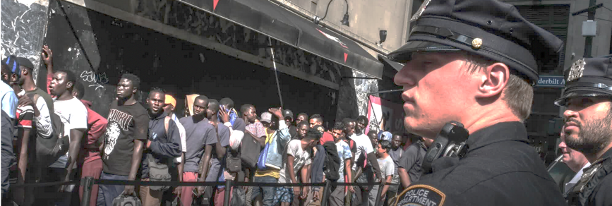
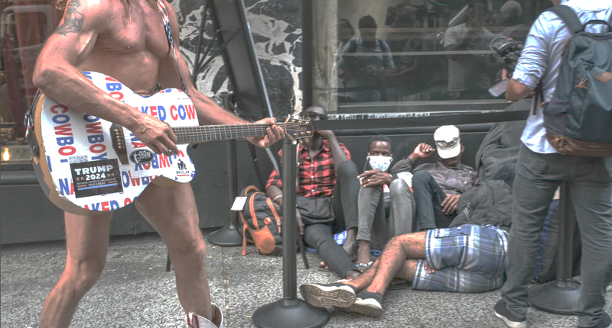
When one visits Rome, and sees everywhere the ruins of an ancient, magnificent civilization, one can’t help but ask: What happened? How did the most powerful and prestigious empire on Earth at the time, crumble into oblivion? Did it happen all at once, or over centuries? Did the people living during the time of its fall understand what was happening? Could they have prevented it? What policies finally doomed an empire that had stood for a thousand years? How could those presiding over it have allowed the ruination to occur?
We don’t need to ask those questions of ancient Rome, because we’ve got ring side seats to something very similar—happening in our own time. And the answers are obvious. Yes, to anyone paying attention, we do understand that our civilization is crumbling. Yes, it could easily be prevented—with different policies from our leaders. But unless those leaders are changed, our own “decline and fall” in fact becomes as inevitable as was ancient Rome’s.
I started noticing this phenomenon when I’d visit Dubai. As arrogant Westerners, we’ve grown up in a world where we’re on top of humanity’s pyramid. They even have a name for it: First World country. Yep. That was us. The United States of America. We’d put a man on the moon. We’d made most of the major scientific inventions. And we were generating almost 40% of global economic activity, from only 4% of the Earth’s population.
But when you’ve been to Dubai and you fly home either to Europe or the United States, you realize we’re a civilization in decline. Whether it’s London, New York, or San Francisco, the cancer of graffiti is everywhere, on all our public surfaces. Trash blows around and no one cares. Panhandlers fight for who gets to camp out at the most lucrative intersections, with made up tales of woe, on cardboard. Drug addicts and the mentally ill are not confined to treatment facilities as a sane society would do, but instead sleep on our sidewalks and in our parks—creating a dystopian spectacle of a declining civilization.
When we live here we don’t notice it. It happens too slowly and we acclimate. But a trip to Dubai (equally Singapore) kind of resets the senses. You realize there’s no reason urban areas have to look like they increasingly do in America and Europe. You see a truly world-class city with zero graffiti, zero panhandling, zero people sleeping on public sidewalks, or using parks as their personal toilets. In short, you see life as it was in the United States fifty years ago—before today’s politicians took over with misguided policies piled onto misguided policies.
Could present-day people—if given a time machine—go back to ancient Rome in the early Fifth Century and tell the leaders how to save their civilization? Well, we could tell them, but would they listen? Or if they listened, would the political will have existed to make changes?
I’m guessing not, because we’re living through the same thing today. What kind of society builds a lavish social welfare state, and then opens its border and essentially invites in…the other 96% of the world’s population? And then offers to feed them, house them, furnish unlimited medical care, provide for them in every way, and even educate their kids? And offers to do all this when the people arriving are unskilled, do not speak our language, and generally have little in common culturally with the folks who are taking them in. And further, what civilization arranges laws such that when these folks do arrive, they’re not allowed to seek work and support themselves. They go directly onto the welfare rolls without even passing GO. And stay there.
Finally, imagine a society that not only takes these people in (which at least is compassionate) but then provides them shelter not in simple, rudimentary tents or inexpensive pre-fab housing in low-cost areas…but lodges them instead in the most expensive real-estate locations in the entire country, and in the most prestigious, luxury hotels?
A society that does this is not a society that’s going to survive. Equally, it’s not a society that should survive. Time to let this one go the way of the Romans. And see if whatever comes next can do better.
On present trend lines, the United States of America—once that shining city on a hill—will soon be replaced with one big “Darwin Award.”
Will future civilizations learn from our Decline and Fall? Did we learn from those who came before us?
Sadly, the questions answer themselves.
 Jacques Voorhees